
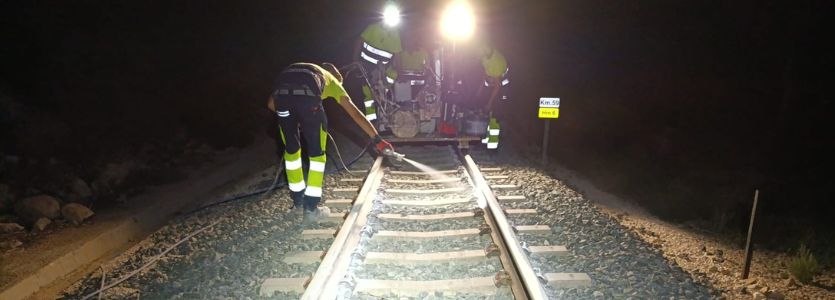
- TRAM d’Alacant is conducting initial tests on Line 9 by painting a 5 km stretch of track white to reduce the thermal effect on the rails
- The study and analysis of the results are being carried out through the Vialobra Railway Chair
Ferrocarrils de la Generalitat Valenciana (FGV) and the Universitat Politècnica de València (UPV) are developing a project to mitigate the impact of extreme heat on railway infrastructure.
The study and testing have been driven by a university-industry partnership through the Vialobra Railway Chair. Initial measures are already underway on the TRAM d’Alacant network, specifically along various sections of Line 9, which connects Benidorm and Dénia.
Painting specific track sections white is being analyzed to verify the measure’s benefits in reducing potential track deformation (buckling).
The research aims to determine the extent to which rail temperatures can be lowered using paints with specific properties. It is worth noting that, while some railway authorities are already applying this method, there is a lack of accessible, rigorous data on the results, making the current research particularly important.
To date, work has focused on ballasted track curves with a radius of less than 200 meters; applying white reflective paint reduces the steel’s surface temperature by approximately 8–10°C, thereby increasing the safety margin against thermal expansion.
Currently, as part of FGV’s maintenance operations in Alicante, over five kilometers of track have been painted, and plans are in place to extend this work to various surface-level sections of the Metrovalencia network.
Increasingly Extreme Conditions
In the face of increasingly extreme weather conditions, and alongside standard planning and preventive maintenance, it is necessary to devise innovative strategies to ensure proper infrastructure preservation. Extreme weather events have ceased to be anomalies and have instead become standard planning scenarios.
FGV is not a conventional network; it combines long surface-level sections with underground and tramway segments. In Valencia, there are over 100 kilometers of surface track, while in Alicante, the lines traverse the coastal strip of the l’Alacantí, Marina Baixa, and Marina Alta districts. This terrain is complex, featuring cliffs, ravines, and hillsides, as well as sections that wind through tight curves and steep gradients.
Given these conditions and the network’s specific characteristics, FGV implements various measures to address climate change and mitigate its direct impact on the surface railway infrastructure.
These measures include reinforcing the trackbed through the construction of ballast-retaining walls and the installation of sleepers; identifying and removing weakened trees at risk of falling; thoroughly inspecting and cleaning ditches, drainage collectors, and culverts during the summer; and periodically clearing dry vegetation from areas adjacent to the track to eliminate fire risks.